How Many Wraps of PTFE Tape? Turns, Layers and Thread Size
How Many Wraps of PTFE Tape? Turns, Layers and Thread Size
Direct answer
There is no universal PTFE tape wrap count based on pipe size alone. Select the permitted sealant, tape width, thickness and density, then follow a confirmed procedure for the fitting. Control tension and overlap as well as turns. A product-specific minimum is not a complete recipe, and adding tape cannot correct damaged threads or an unsuitable sealing interface.
 | By Liu Yingbao Engineer · 20 years experience in PTFE line |
If you are asking how many wraps of plumbers tape to apply, first define what is being counted. One revolution, a full pass along the threaded zone and the local number of layers are different quantities. Compare the ForeverSeal PTFE thread seal tape range by specification rather than spool appearance.
1. Start with the Connection, Not a Number
Confirm that the joint is designed to use thread sealant. A compression nut, flare connection or washer-sealed coupling does not become a pipe-thread seal merely because it has threads.
Record the thread standard, nominal size, fitting material and condition. Nominal size is not the measured outside diameter. A larger diameter also does not automatically mean a higher pressure or a proportionally larger thread clearance.
The earlier PTFE tape installation guide explains how to choose width before wrapping. Here, the focus is controlling the amount applied.
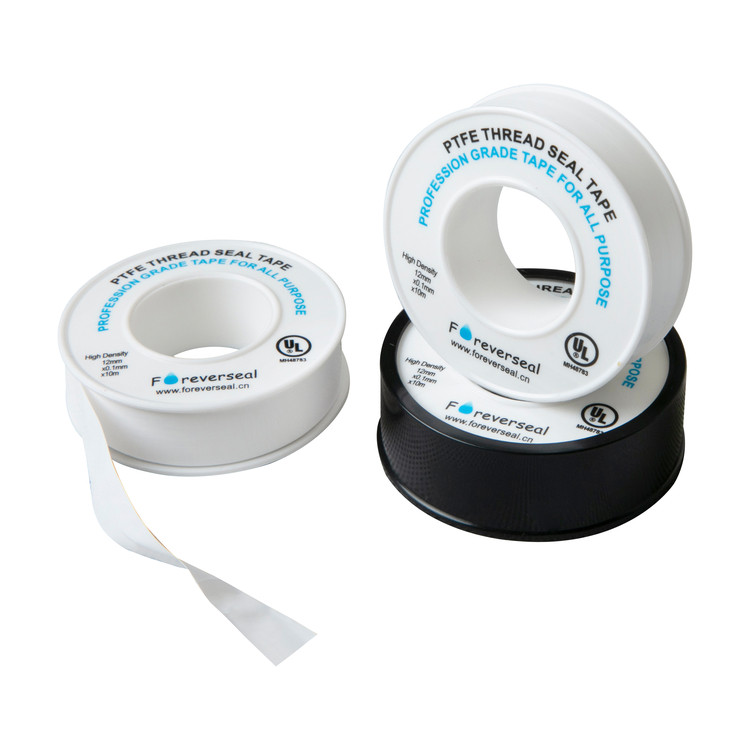
Tape thickness, density and wrapping technique all affect the amount applied to a threaded joint.
2. Turns, Passes and Layers: Three Different Measurements
| Term | Meaning | Why the distinction matters |
|---|---|---|
| Turn or wrap | One complete revolution around the fitting | Does not identify axial coverage |
| Pass | A traversal of the intended threaded zone | May require several revolutions |
| Local layer count | Number of tape layers at a particular location | Changes with overlap and stacking |
| Tape length | Strip consumed during wrapping | Also depends on circumference and travel |
Two workers can count five turns but leave different coverage. One may stack turns in a narrow band; another may progress along the threads. The instruction needs both the count and the wrapping pattern.
Define Overlap Before Comparing Operators
In an ideal uniform helical pattern, axial advance per revolution is strip width multiplied by one minus the overlap fraction. For an unstretched 12 mm strip, 50% overlap gives 6 mm advance, while 70% overlap gives 3.6 mm.
These are geometric illustrations, not recommended settings. They show why the same turns can cover different lengths. Real tape changes under tension, and the beginning and end of a wrap introduce additional variation.
3. How Thread Size Changes Tape Consumption
A larger circumference consumes more tape per revolution. It does not by itself dictate how many local layers are needed.
| Nominal fitting examples | Check before setting a wrap procedure |
|---|---|
| 1/4 and 3/8 in. | Short sealing zone, narrow tape requirements and bore clearance |
| 1/2 and 3/4 in. | Actual engagement, permitted width and wrapping pattern |
| 1 in. and above | Coverage, tape consumption, assembly limits and fitting condition |
| Any damaged or mismatched thread | Correct the component problem instead of adding layers |
Use a qualified product-and-fitting procedure rather than turning this size table into a fixed count chart. For planning, the ForeverSeal tape calculator can assist with estimates; it does not certify a completed joint.
4. Thickness and Density Change the Material Applied
Thickness describes the strip dimension. Density describes mass per unit volume. Neither is a standalone pressure or sealing-performance rating.
| Example specification | Thickness | Density | Calculated mass per area |
|---|---|---|---|
| Aqua AQ-W12-T10-D4 | 0.10 mm | 0.4 g/cm³ | 40 g/m² |
| Aqua Pro AQP-W12-T10-D7 | 0.10 mm | 0.7 g/cm³ | 70 g/m² |
| Industrial ID-W12-T10-D10 | 0.10 mm | 1.0 g/cm³ | 100 g/m² |
Source: supplied ForeverSeal Aqua and Industrial TDS. Calculation: density × thickness in mm × 1,000 = g/m². These are model specifications and calculated material quantities, not measured leak rates or certification mappings.
Equal turns of equal-width tape with different density do not apply equal material mass. Conversely, equal mass does not establish equivalent installed structure. Do not calculate a new wrap count by multiplying or dividing density alone.
5. What Does the Three-Wrap Minimum Actually Mean?
The supplied Aqua and Industrial TDS specify a minimum of three wraps for those products. Read that statement with the complete instructions and the fitting requirements. It is not a maximum, a guarantee, or a universal rule for every tape.
The internal pipe-size note also lists 3–5, 5–7 and 7–10 turns as workshop experience ranges for increasing size groups. Without a defined tape SKU, thread condition, overlap and test method, those ranges cannot become a general installation chart.
For a confirmed water application, review ForeverSeal Aqua PTFE tape. Do not transfer its procedure to an unrelated specialty product without checking.
6. Brass, Steel and PVC: Why Material Changes the Decision
Brass and steel joints need inspection for damage, matching threads and correct assembly. Stainless steel adds concern about galling, while plastic connections require careful attention to permitted sealant and tightening.
Material names do not supply a valid numerical correction such as “add two turns for steel” or “halve the turns for PVC.” Some plastic-fitting manufacturers permit specified tape; others instruct a different sealant. Check the actual component documentation.
For details, see PTFE tape on brass, PVC, stainless and steel fittings.
7. Too Much or Too Little? Diagnose Instead of Guessing
| Observation | Possible issue | Response |
|---|---|---|
| Tape bunching | Direction, loose tension or excessive build-up | Stop and inspect the wrap and engagement |
| Immediate abnormal resistance | Cross-threading, mismatch or excess material | Do not force the fitting |
| Loose tape at the bore | Width, start position or finishing issue | Remove and rewrap safely |
| Leakage after assembly | Many possible selection or component faults | Diagnose and retest; do not assume one extra turn will fix it |
Appearance and turning feel are useful observations, not proof of sealing. Do not loosen an assembled connection for alignment unless its procedure permits it.
8. Standardize a Repeatable Wrapping Procedure
For repeated assembly, document the fitting specification and source, tape SKU, width, thickness and density, start position, overlap, tension method, turns, tightening procedure and test acceptance criteria.
Recheck the process when a significant input changes. Tape lot consistency matters, but so do operator consistency and fitting variation. Discuss ForeverSeal Industrial tape specifications against the equipment requirements rather than a generic heavy-duty label.
9. Get Help Defining the Right Tape and Procedure
Send ForeverSeal the thread standard, size, fitting material, medium, operating conditions and present tape specification. We can discuss product options and supporting technical information for your evaluation.
For related reading, review PTFE tape grades and specifications.
10. Frequently Asked Questions
How many times should I wrap plumbers tape on 1/2-in. pipe?
Use the exact tape and fitting instructions. Nominal size alone does not establish a count; width, thickness, density, tension and overlap also matter.
Do more layers always seal better?
No. Excess material can interfere with engagement and loading. Tape cannot repair damaged or incompatible threads.
Can high-density tape always use fewer wraps?
No. Some specific products have their own instructions, but density alone does not provide a reliable conversion.
Can I add tape outside an assembled leaking joint?
External wrapping does not recreate the internal thread seal. Make the system safe and diagnose the connection.
Is a neat wrap enough to approve the joint?
No. Complete the specified inspection and pressure or leak test before service.