PTFE Tape Thickness and Density: How to Choose the Right Spec
PTFE Tape Thickness and Density: How to Choose the Right Spec
Direct answer
Choose PTFE tape by service suitability first, then specify thickness, density, width and length separately. Thickness measures the strip; density measures mass per unit volume. Together they determine nominal material loading, but neither proves pressure capability or a universal wrap count. Compare exact product data, component instructions and applicable approvals rather than relying on “high-density” labels alone.
 | By Liu Yingbao Engineer · 20 years experience in PTFE line |
Two rolls can look alike and carry different quantities of material. A useful purchase specification makes that difference measurable. Start with the ForeverSeal PTFE thread seal tape range and specifications, then match an exact model to your connection and service.
1. PTFE Tape Thickness: Convert mm, Microns and Mil
A mil is one-thousandth of an inch, not a millimetre. Using the exact conversion 1 mil = 0.0254 mm, the following dimensions can be compared directly.
| Thickness in mm | Thickness in microns | Thickness in mil, rounded |
|---|---|---|
| 0.075 mm | 75 µm | 2.95 mil |
| 0.10 mm | 100 µm | 3.94 mil |
| 0.15 mm | 150 µm | 5.91 mil |
| 0.20 mm | 200 µm | 7.87 mil |
Source: NIST unit conversion; table values are calculated. The last two rows are dimension examples, not a claim that every ForeverSeal series offers those thicknesses. The supplied Aqua TDS lists 0.075 and 0.10 mm options; many other supplied series list 0.10 mm.
Include the Measurement Method and Tolerance
Soft, compressible tape can give different readings under different measuring pressure. Agree the instrument, contact force, sampling locations and acceptance limits with the supplier. Do not compare an unstretched strip with tape pulled tight on a fitting.
A 0.10 ± 0.01 mm specification covers 0.09–0.11 mm, or ±10% of nominal thickness. State the tolerance in the purchase order; “approximately 0.1 mm” leaves an important detail unresolved.
2. Density and Thickness Describe Different Properties
Tape density in g/cm³ describes mass relative to the tape's measured volume. It should not be confused with the density of solid PTFE resin, or with how firm a wound spool feels.
“Standard,” “high-density” and “double-density” need a supplier's numeric definition. Double relative to which reference? Ask for the actual value and measurement method. A thicker tape is not necessarily a denser tape, and greater density alone does not establish better elongation, tear resistance or sealing performance.
Our PTFE thread seal tape grades guide explains how grade descriptions relate to applications and approval requirements.
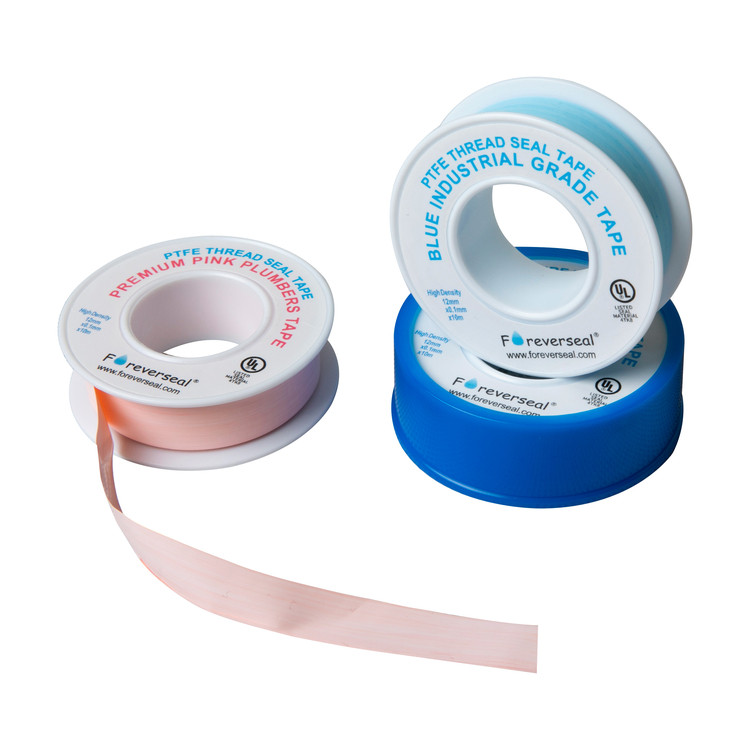
Industrial tape examples from the ForeverSeal image library. Color and appearance do not measure thickness or density; use the specified model and its documentation.
3. Compare ForeverSeal Models with the Same Thickness
| Model in supplied TDS | Nominal thickness | Nominal density | Calculated mass per area |
|---|---|---|---|
| Aqua AQ-W12-T10-D4 | 0.10 mm | 0.4 g/cm³ | 40 g/m² |
| Aqua Pro AQP-W12-T10-D7 | 0.10 mm | 0.7 g/cm³ | 70 g/m² |
| Industrial ID-W12-T10-D10 | 0.10 mm | 1.0 g/cm³ | 100 g/m² |
| UltraGas UG-W12-T10-D10 | 0.10 mm | 1.0 g/cm³ | 100 g/m² |
| Xtreme XM-W12-T10-D15 | 0.10 mm | 1.5 g/cm³ | 150 g/m² |
Source: supplied ForeverSeal series TDS, exact model rows. These are nominal manufacturer specifications and calculated material quantities, not comparative leak-test results. Other market variants exist; the model suffix and agreed order specification matter.
Calculate Material Loading Without Predicting a Seal
For consistent units, mass per area (g/m²) = density (g/cm³) × thickness (mm) × 1,000.
For a nominal 12 mm × 10 m strip at 0.10 mm, the calculated tape mass is 4.8 g at 0.4 g/cm³, 12 g at 1.0 g/cm³ and 18 g at 1.5 g/cm³. These hypothetical equal-length comparisons exclude the spool and packaging; they do not describe the listed length of every model above.
At the same dimensions, 1.0 g/cm³ gives 2.5 times the mass of 0.4 g/cm³. That is a material-loading ratio, not 2.5 times the pressure rating or a formula for reducing turns.
4. Match the Specification to Water, Gas, Oil and Temperature
| Application | Selection priority | ForeverSeal reference |
|---|---|---|
| Potable or industrial water | Exact model, water-contact requirements and fitting suitability | Aqua or Aqua Pro |
| Fuel gas | Applicable gas documentation, covered model and operating limits | GasSafe; confirm exact scope |
| Industrial oil | Actual fluid, additives, temperature and component instructions | Industrial, subject to application review |
| Oxygen or high-purity gas | Service-specific assessment and controlled cleanliness | UltraGas, subject to exact documentation |
| Vacuum or thermal cycling | Complete-joint suitability and defined acceptance testing | Xtreme, subject to application review |
For buyers seeking high density PTFE tape, a density figure should narrow a specification after service suitability is established. Selecting PTFE tape for oil also requires the actual oil and operating conditions, rather than a generic “industrial” label.
The current ForeverSeal UltraGas PTFE tape for oxygen and high-purity gas applications lists 1.0 g/cm³ and 0.10 mm. Its distinguishing application requirements are not captured by calling it a double-density fuel-gas tape. Equal dimensions do not make Industrial and UltraGas interchangeable.
Likewise, a search for high temp thread tape must lead to a complete service review. A tape material temperature range does not establish the allowable pressure at that temperature for the fitting, pipe or assembled system. Approval limits can be narrower than broad TDS material values.
5. Why Thicker Tape Does Not Give a Fixed Wrap Reduction
The installed layers depend on usable thread length, tape width, overlap, tension and compression during assembly. A thick strip can build up quickly in a short or delicate connection; a thin strip may require a different application procedure. Neither observation creates a universal conversion between thickness and turns.
Do not assume that thicker tape tears more easily: formulation, tensile properties, thread burrs and handling also affect tearing. Use the specified procedure and check the complete joint. The PTFE tape wrap-count guide separates revolutions, coverage and local layers.
6. A Practical Specification for Consistent Purchasing
Request these items together when comparing quotations:
• Exact series and model, intended fluid and applicable documentation.
• Width, thickness, density and length, with agreed tolerances.
• Measurement methods, sampling plan and batch identification.
• Packaging cleanliness where required, storage instructions and traceability.
• The approved assembly procedure for your fitting and the system acceptance test.
For a batch check, weigh a known strip length without the spool and compare its mass per area with the agreed specification. Use measured width and thickness when calculating density. This is a dimensional consistency check, not a substitute for service qualification or leak testing.
Explore ForeverSeal PTFE tape manufacturing and quality control and request the records relevant to your order. Do not treat a general factory description as a batch inspection certificate.
7. Specify Your PTFE Tape with ForeverSeal
Send the thread standard and size, fitting materials, medium, operating conditions and required approvals, together with your target dimensions and tolerances. If you are replacing an existing tape, include its specification and installation method so the comparison is meaningful.
Contact ForeverSeal for PTFE tape specifications, technical documents and samples. We can help compare available models and prepare a clear specification for your evaluation.
8. Frequently Asked Questions
Is 0.10 mm tape the same as 4 mil?
It is approximately 3.94 mil. Exactly 4 mil is 0.1016 mm. Compare the stated nominal values and tolerances rather than assuming they are identical specifications.
Does high density mean fewer wraps?
No fixed reduction follows from density alone. Use the confirmed tape-and-fitting procedure and control width, tension and overlap.
Is double-density tape a universal grade?
Ask for its numerical density and reference grade. The label alone does not establish a cross-supplier specification or approval.
Can I compare roll weight to check density?
Not without separating tape from the spool and packaging and accounting for width, thickness and length. Prefer an agreed strip measurement and sampling method.