Which Way Do You Wrap Teflon Tape? Clockwise Direction Explained
Short answer
Wrap PTFE tape in the same direction the thread tightens. On almost every fitting you will meet — every standard right-hand thread — that means clockwise when you look straight at the end of the male thread. Wrapped the other way, the tightening rotation unwinds your seal instead of compressing it.
The thread itself always tells you the answer. You do not need to memorise a rule; you need to read the thread in front of you.
If you searched for which way to wrap teflon tape, the whole answer in one sentence: clockwise on a right-hand thread, counter-clockwise on a left-hand thread, always following the direction the fitting turns as it goes in.
Teflon Tape Direction: Why Wrapping the Wrong Way Causes Leaks
A tapered pipe thread does not seal because of the sealant alone. When male and female threads are screwed together, the 1:16 taper generates radial interference and the crests press into the roots with high local contact pressure. That metal-to-metal interference is the actual seal.
PTFE thread seal tape is not the primary seal. It is a gap filler. Even on a well-machined thread pair, a microscopic helical channel remains at the thread root — a leak path running the length of the engagement like a spiral. Tape fills that channel. That is the whole job.
Now the direction question. A thread is a one-way ramp. As the fitting is driven in, each thread flank acts on the film ahead of it, pushing it forward and compressing it against the root of the next thread. Wrapped the same way, the tape is loaded in compression: squeezed harder the tighter you go, bedding into the root it was meant to fill.
Wrapped the other way, the same helix works against you. Each flank now drags backwards across the film, lifting it off the root it was bridging and wrinkling it ahead of the thread crest. The joint goes in dry, feels correct, passes a hand check — and then weeps.
What the standards actually say
Direction is not folklore. It is built into the tightening procedure that surrounds ASME B1.20.1 (NPT) and EN 10226-1 / ISO 7-1 (BSPT). Manufacturer installation data for tapered fittings consistently specifies 2 to 3 clockwise wraps viewed from the pipe end, starting one thread back from the tip, followed by 3 to 4 further turns past hand-tight.
The European gas standard is more explicit still. EN 751-3:2022+A1:2023, covering unsintered PTFE tapes and strings for metallic threaded joints in contact with first, second and third family gases, classifies tape by thread type — class F for fine, class G for coarse — and tests to 500 kPa in gas, 700 kPa in heating hot water and 20 kPa in gas appliances and their auxiliary equipment, with a maximum working pressure of 2000 kPa relevant to LPG storage, over a -20 °C to +125 °C range. Its premise is that the tape is compressed by correct-direction tightening into the root of a thread conforming to EN 10226-1:2004.
For general service, BS 7786:2006 covers unsintered PTFE tape at 25 to 300 g/m² and 0.05 to 0.25 mm, across -270 °C to +260 °C — a deliberately wide envelope, because in non-gas service the material, not the direction, does the chemical work.
How to Tell Which Direction to Wrap Plumber's Tape on Threads
Stop guessing from memory. Three methods identify the tightening direction, in order of reliability. All three reach the same answer, so if the first looks ambiguous, use the next.
If you have heard conflicting advice about plumbers tape direction, the disagreement is almost never about the principle. Every standard and every experienced installer agrees the tape goes on in the tightening direction. The confusion comes from the viewing angle. Clockwise is only meaningful once you fix your viewpoint: it means clockwise looking directly at the end of the male thread, with the roll travelling left to right around the visible spiral. Described from behind the fitting, the same rotation reads as counter-clockwise. That ambiguity is where the myths come from.
Method 1 — Read the thread
Hold the male thread so the open end faces you. Look at how the spiral rises as it recedes. If it rises away to the right and falls toward you, the tightening rotation is clockwise, and that is your wrap direction. If it rises the other way, the fitting turns counter-clockwise and so must the tape. This takes three seconds and is never wrong.
Method 2 — The dry-fit test
Screw the male fitting into its mate by hand with no tape on it. Note the direction it turns. That direction is your wrap direction. Ten seconds, and it removes all doubt.
Method 3 — The marking convention for British pipe
British Standard Pipe threads are designated by letter, and the letter tells you both the form and the sealing method before you touch the tape.
| Designation | Form | Standard | Flank | Taper | Seal method | PTFE tape |
|---|---|---|---|---|---|---|
| NPT | Tapered | ASME B1.20.1 | 60° | 1:16 | Thread interference + sealant | Yes — 2 to 3 wraps |
| NPTF dryseal | Tapered | ASME B1.20.3 | 60° | 1:16 | Metal-to-metal, no sealant | No |
| R / Rc BSPT | Tapered | ISO 7-1 / EN 10226-1 | 55° | 1:16 | Thread interference + sealant | Yes — 3 to 5 wraps |
| G BSPP | Parallel | ISO 228-1 | 55° | Parallel | Washer / bonded seal / cone seat | No — washer or O-ring |
Both tapered families share the same 1:16 taper, so NPT and BSPT run in for two or three turns by hand before the 5° flank difference announces itself — usually as a sudden bind under torque, or a joint that will not fully seat. That is why a mismatched pair leaks regardless of tape quantity. Use an adapter.
Pipe Tape Direction for Right-Hand vs Left-Hand Threads
Right-hand thread is the overwhelming default. Turning the fitting clockwise drives it deeper. Threads are stamped, cast or machined RH by default under ASME B1.20.1 and ISO 7-1, which is why clockwise is the safe default answer. Roughly 95 % of fittings in service are right-hand.
Left-hand thread exists and is not exotic. You will meet it on certain gas appliance and regulator connections, particularly legacy European and UK installations; on some older radiator valves and thermostatic controls, where the union nut must not unscrew during service; on axial-flow and special-purpose equipment such as pump housings and boiler trim; and on any assembly where a component must be removed without disturbing a neighbouring joint — a deliberate design choice.
If you have already applied tape the wrong way on a left-hand thread: unwind it completely, discard that section of the roll (it has lost tension and thickness), clean the thread, and re-wrap counter-clockwise. If you cannot be certain whether the thread is RH or LH, do not guess — dry-fit it, or check the fitting marking against the drawing.
Which Way to Wrap Plumber's Tape: Step-by-Step With Tension Control
Direction is necessary but not sufficient. A correctly wound tape applied with slack, over-wrapped, or started on the wrong thread still leaks. Work through this sequence.
01
Strip and inspect the male thread
Remove every trace of old tape, pipe dope, rust, burrs and metal chips with a stiff nylon or brass brush, then wipe clean and let it dry. A burr cuts the film and opens a leak path; residual old tape stops new tape bedding into the root; oil and water prevent adhesion. Any thread that is galled, stripped or deformed must be replaced — thicker tape will not rescue a damaged thread, and a deformed thread under gas service is a defect, not a sealing challenge.
02
Confirm the thread form and the tightening direction
Identify the thread as NPT, BSPT (R/Rc) or parallel BSPP (G) before you touch the roll. Parallel BSPP seals on a washer, bonded seal or cone seat — tape there is at best redundant and at worst prevents the washer from seating flat. The designation map is in the table above.
03
Start on the second thread, not the first
Anchor the tape on the second thread from the end of the male thread so the first thread stays bare. This single habit prevents the most common non-directional failure there is: the end thread shearing during tightening, the shred travelling into the bore, and that shred lodging in a control valve, a flow sensor or a small instrument passage. Some installers cover the first thread with the final wrap — acceptable, provided the tape cannot be torn free at the edge.
04
Wrap in the tightening direction with even tension
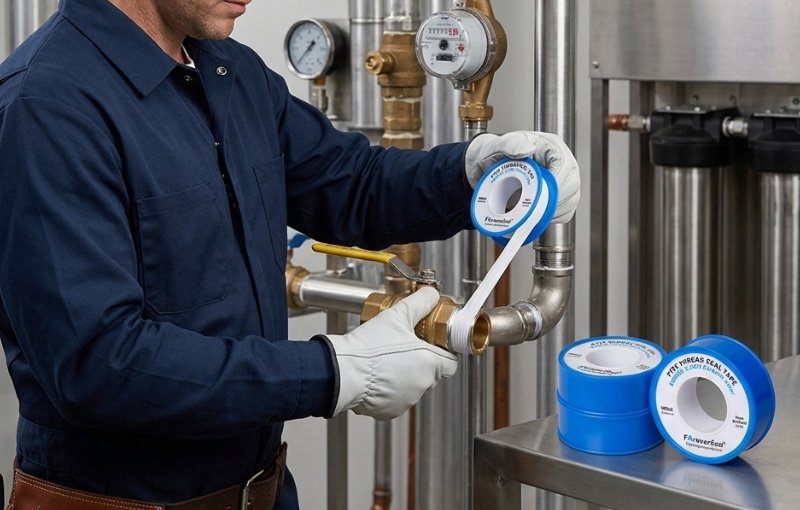
Hold the male thread end facing you. For a right-hand thread, wrap clockwise, left to right as the roll travels around the thread — which way to wrap plumbers tape is answered by watching the spiral, not by habit. Maintain firm, steady tension: enough that the film flattens into the root without tearing, not so much that it stretches thin or necks. Each wrap overlaps the previous by roughly half the tape width, so no thread land is left exposed.

05
Use the wrap count the material and thread size demand
Wrap count is not a fixed number. It scales with tape width, thread pitch, thread diameter and film density.
| Thread standard | Standard density (0.3–0.5 g/cm³) | High / full density (0.9–1.5 g/cm³) | Wrench turns past hand-tight |
|---|---|---|---|
| NPT up to 3/4 in. | 3–4 wraps | 2–3 wraps | 3–4 turns |
| NPT 1 in. and above | 4–6 wraps | 3–4 wraps | 3–4 turns |
| BSPT (R/Rc) | 4–5 wraps | 3–4 wraps | 1.5-2.5 turns |
| Gas service (EN 751-3) | Not permitted | 3–4 wraps, gas-rated grade | Per joint specification |
| Hydraulic / high pressure | 2 wraps max | 2 wraps max | To fitting torque spec |
The hydraulic row is not a typo. For instrumentation and high-pressure ports, accepted practice is 1.5 to 2 turns maximum — excess film bunches under torque and creates its own leak path, and on thin-wall stainless or aluminium fittings it adds radial stress. Use the same table when a specifier asks how to state pipe tape direction in a tender document: give the thread standard, the wrap count, the starting position and the tightening turns. Those four figures are what an inspector checks.
06
Tear, press down, then assemble to a measured torque
Tear the tape cleanly against the thread, then press the loose end flat into the last wrap with your thumb so it cannot lift during threading. Screw the fitting in by hand until snug — that is your hand-tight reference, typically 2 to 3 turns on a new fitting. From there apply the wrench and count turns, not flats. Do not keep tightening past the point where the film stops compressing. Over-tightening strips the film out from between the crests, leaving metal-to-metal contact and no sealant at all, and can crack a female fitting or gall stainless threads.
07
Verify before you commission the line
Wherever the code allows, pressure-test the completed joint at 1.5× the intended operating pressure. For any fuel gas connection, run an explicit leak test with a commercial leak-detection solution or a calibrated gas detector before the system is put into service — never rely on the absence of odour. A correctly assembled NPT joint with correctly applied sealant should show zero detectable leakage.
If a joint you have just assembled does leak, do not simply add more tape. Back the fitting off, inspect the threads for damage or cross-threading, clean both sides, and reassess whether the thread forms actually match. Progressive over-wrapping on an already-stripped thread hides the real fault and can drive debris into the line.
FAQ: Does Teflon Tape Direction Really Matter for Gas Fittings?
Short answer: yes, and for fuel gas it matters more than any other single step in the procedure. Direction is a code-relevant part of the installation, not a nicety.
Which direction to wrap teflon tape on a left-hand thread?
Exactly the opposite — counter-clockwise viewed from the end of the male thread, following the direction the fitting turns as it enters. The principle has no exception: which direction to wrap teflon tape is decided by the thread, not by the material, the brand, or the colour of the roll.
Does the direction of the wrap actually change the outcome, or is it just convention?
It changes the outcome. The thread helix converts rotational input into a one-way axial force on the film. Correct wrapping puts that force into compression against the thread root, so the seal improves as torque rises. Incorrect wrapping reverses the load: the film is dragged backward, lifts off the root, wrinkles ahead of the thread crest and leaves a continuous helical channel. The joint can feel correct and still leak under pressure.
Which way do you wrap teflon tape for gas lines?
The same way as any tapered thread — in the tightening direction, so clockwise viewed from the end of the male thread on a right-hand fitting. What changes on a gas line is not the direction but the tape: it must be a gas-rated grade, and the wrapping discipline has to be tighter. Standard white tape is not permitted. UPC 2021 §1210.2 requires thread seal tape on threaded joints to be listed to ASTM D3308, and IFGC 2021 §403.6 requires that pipe joint compounds and tapes be approved for the application and applied to male threads only. In Europe the equivalent comes through EN 751-3:2022+A1:2023, which classifies gas tape as class F or class G by thread type and tests it accordingly. In the United States the listing route is UL Component Recognition (category 31RO for gas sealants) plus CSA certification — not A-A-58092, which governs unsintered tape for liquid and gaseous oxygen service. Colour alone is never sufficient; the spool must carry a printed listing for fuel gas.
How many wraps do I actually need on a gas fitting?
Three to four wraps of a gas-rated high-density tape is the normal range, adjusted for tape width and thread size; small NPT threads up to 3/4 in. typically need only two to three. More tape does not improve the seal. Excess acts as a wedge, makes hand-threading harder, and on brittle materials such as cast bronze or PVC can crack the body or the female thread when tightening force passes through it.
Does it matter if I skip the first thread?
Yes — this is debris control, not sealing. If tape reaches the very edge of the thread, tightening can shear shreds into the bore, and those shreds end up loose inside the line where they can block strainers, seats and small instrument passages. Leave the first thread free, or cover it with the final wrap so it cannot be torn off at the edge.
Can I reuse the same tape on another joint?
No. Once a section has been wound and unwound it has lost tension and usable thickness. Replace the joint with fresh tape every time it is broken — including stainless steel, where anti-seize should be applied to the threads before the tape goes on to prevent galling.
What about NPTF dryseal threads — does direction still apply?
Direction does not apply because tape does not. NPTF (ASME B1.20.3) is designed to seal metal-to-metal with no sealant. Applying tape to an NPTF port defeats its design intent and can prevent the interference fit. NPT and NPTF are dimensionally compatible and can be mated, but the dryseal performance of the NPTF side is lost — put the tape on the NPT side only.
What happens if I mix NPT and BSPT?
They will run in for two or three turns by hand because the 1:16 taper is identical, then bind, cross-thread and leak under torque. The 60° versus 55° flank difference creates a gap far larger than a 0.1 mm tape can bridge, and the mismatch shreds film into the line. Use a dedicated adapter — never tape over a thread-form mismatch.
Master the Wrap — Then Match the Tape to the Service
Direction is a five-second decision made once per joint. Tape specification is the decision that follows you through the life of the system.

Foreverseal grades unsintered PTFE thread seal tape into four density classes, so a specifier can match the film to the service instead of guessing from colour.
Standard
0.25 – 0.35 g/cm³
Residential water, low-pressure air, general plumbing. 4–6 wraps.
Medium
0.35 – 0.8 g/cm³
Commercial water, potable systems, general industrial work. 4–5 wraps.
High
0.8 – 1.0 g/cm³
Compressed air, steam, HVAC, equipment manifolds. 3–4 wraps.
Full
1.0 – 1.5 g/cm³
Natural gas, LPG, oxygen service, aggressive chemicals, high pressure. 2–3 wraps.

Higher density means a thicker film for a given width, so fewer wraps reach the same gap-fill — which is why full-density gas tape is specified at 2 to 3 wraps where standard-density tape needs 5 to 7. The comparison below is the practical case for matching grade to service rather than colour to habit.
Every grade ships with auditable documentation, and the certificate numbers are printed on the datasheet and the box — not just claimed on a web page.
Where a joint sees frequent maintenance, frequent re-threading or thermal cycling, PTFE tape is the right choice precisely because the joint can be broken and remade without destroying it — always replace the tape on reassembly. Where clearances are large, threads are damaged, or the joint must stay permanently rigid and vibration-resistant without depending on the thickness of a hand wrap, a cured anaerobic or liquid thread sealant is the correct tool instead. The full step-by-step application guide for water systems is on the Foreverseal Aqua™ thread seal tape page; gas-rated grades and their approvals are on the GasSafe™ page, and oxygen and high-purity service is covered on the oxygen and specialty gas systems reference.
If a specification is still open, send us the thread standard (NPT, BSPT or BSPP), the medium, the operating pressure and the service temperature, and we will confirm the density grade, the wrap count and the document coverage — fiona@foreverseal.com reaches a real engineer, usually the same working day. For sizing before you buy, the PTFE tape calculator works out coverage per roll from your width, thickness and length, and the complete certificate list is on the quality and certifications page. Distributors and OEM programmes can start from the private label and OEM service page, where custom spool colours, printed cores and barrier packing start at 20,000 pieces, or from the authorised partner programme. Technical datasheets, installation guides and compliance reports sit in the download centre.
Topics: PTFE thread seal tape · plumber's tape · pipe tape direction · NPT · BSPT · ISO 7-1 · ASME B1.20.1 · EN 751-3 · gas line installation · density grades